


AI, Consumer Behavior, Market Research, PR
Your Reputation Is Now a Search Signal
October 1, 2026


Why Reviews Shape Who Gets Found
Imagine two apartment communities a few miles apart. Both are attractive. Both have similar rents and amenities. One has a steady stream of recent reviews mentioning responsive maintenance, friendly staff and an easy move-in. The other has a respectable 4.5-star rating, but most of its reviews are two years old.
Someone asks Google or an AI assistant, “What’s the best apartment community near me with good management?”
Guess which one is more likely to make the shortlist.
Your reputation is no longer just what customers think after they meet you. Increasingly, it determines whether they meet you at all.
Reviews have moved to the front of the decision
Before joining Yellow Duck Marketing, Senior PR Manager Nikki Wolfe worked at Yelp. She saw firsthand how strongly third-party reviews shape discovery, trust and buying decisions. She also saw how quickly a business can mishandle a public response.
That perspective still informs our approach today. A review response is not a private customer-service exchange. It is a miniature press statement with an audience. Future customers are reading it. Search platforms are processing it. And a defensive answer written in a hurry can create a larger reputation problem than the original complaint.
Reviews also appear much earlier in the buying process than they once did. Google Business Profiles, Maps, local search results and AI-generated answers can give someone enough information to call, book, visit or rule out a business without ever reaching its website.
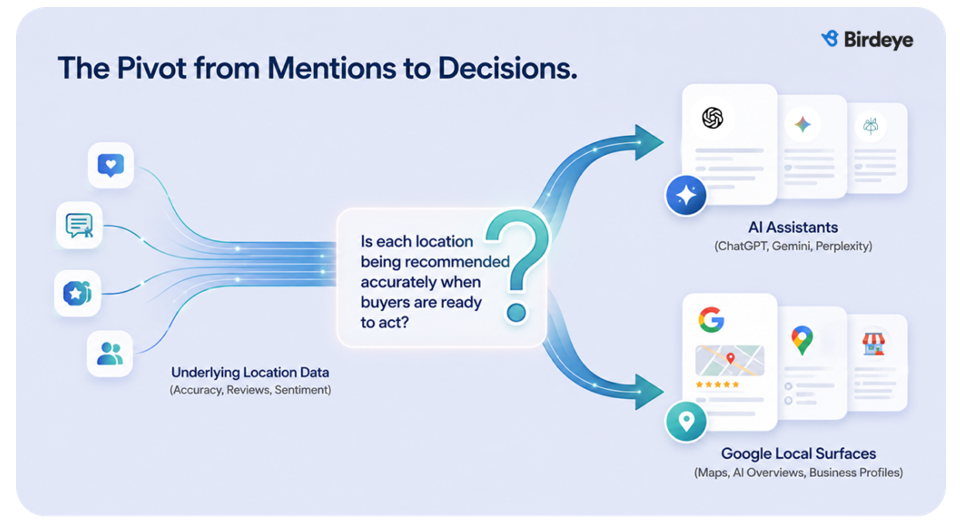
The numbers make the shift hard to ignore. Reputation management company Birdeye reports that review volume grew more than 30% in 2025, the fastest increase since 2021. It also found that more than half of buyers will not consider a business rated below four stars.
Customers are contributing more reputation data and using it to make decisions faster.
AI is reading more than the stars
A five-star review that says “Great!” may help your average, but it does not say much about why someone should choose you.
A recent review that praises a hotel’s quiet rooms, an apartment team’s quick maintenance response or a contractor’s ability to finish on schedule gives customers something useful. It also gives search and AI platforms language they can match to a specific question.
Birdeye demonstrated this in a test of Google’s Ask Maps feature. A newer restaurant with relatively few reviews outranked established competitors for a “best burger” search because one detailed, recent review used the language that answered the searcher’s question and included strong visual proof.
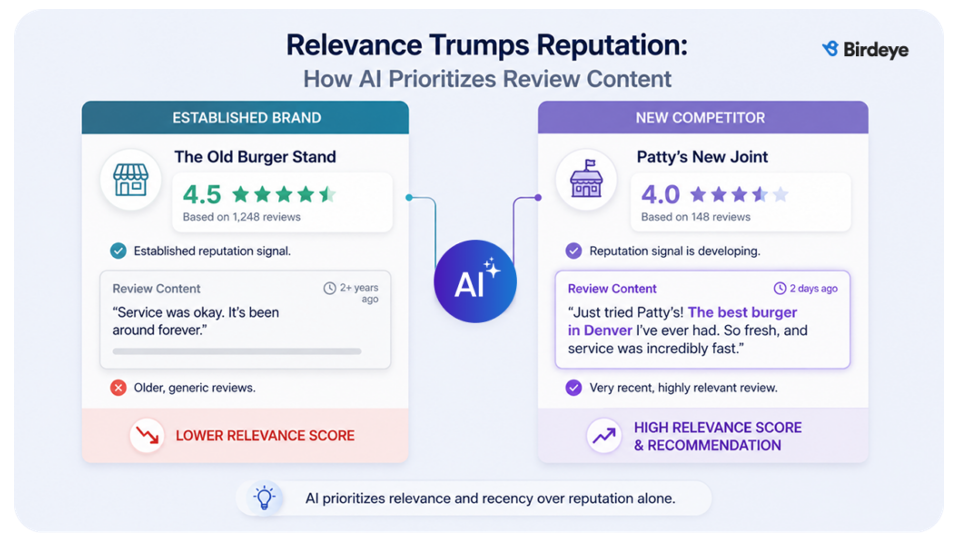
The takeaway is not to coach customers on what to write or cram review requests with keywords. Please don’t. The goal is to make it easy for real customers to describe real experiences. Specific, authentic feedback is far more valuable than a pile of generic praise.
One strong brand can still have a weak location
For multi-location organizations, a healthy corporate reputation can hide a local leak.
A hotel flag may be well known, but a guest is choosing one property. A management company may have an impressive portfolio, but a renter is evaluating one apartment community. One location with stale hours, unanswered reviews or a sudden drop in sentiment can quietly disappear from consideration while the national dashboard still looks reassuringly green.
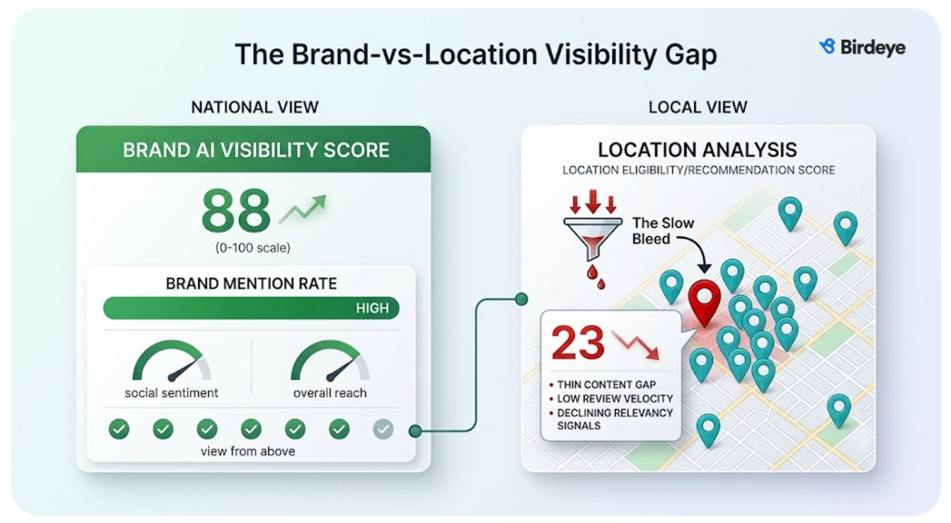
Accuracy matters, too. Birdeye cites research showing that 66% of consumers have arrived at a business only to find incorrect hours or a closed location. Customers do not stop to diagnose a data-governance problem. They simply experience a brand that let them down.
Reputation is built from these small signals: current information, recent reviews, thoughtful responses and a consistent experience from one location to the next.
Every response is a public relations decision
No business avoids every negative review. Nor should a perfectly polished profile be the goal; customers tend to recognize when something looks too perfect. What matters is the response.
A strong response shows that someone is listening. It can add context, demonstrate accountability and move a sensitive conversation offline. It should be timely and human without becoming defensive, sharing private information or promising something the business cannot deliver.
It also needs a little judgment. Is this a routine service recovery? A recurring operational problem? A factual inaccuracy that should be corrected? Or the beginning of an issue that could attract media attention?
That is where reputation management and PR meet. The right answer is not always “respond immediately.” Sometimes the smarter move is to gather facts, align internal stakeholders and respond with the same care you would bring to any other public statement.
Reviews are also remarkably useful customer research. Patterns can reveal a service gap, identify a high-performing team or show that customer expectations have shifted. The review may be public, but the lesson should travel inside the organization.
You need a system, not a scramble
Many organizations still manage reviews through inbox alerts, spreadsheets and whoever happens to remember the password. That works right up until it doesn’t.
A strong reputation-management program should help you:
- Request feedback consistently at the right moment
- Monitor the platforms that matter to your customers
- Respond quickly without losing the brand’s voice
- Keep business information accurate across locations
- Track review volume, recency, ratings and sentiment
- Spot operational or reputational issues before they become patterns
The objective is not a flawless rating. It is a credible, current picture of the customer experience and a reliable process for learning from it.
Where Birdeye and YDM fit
Yellow Duck Marketing offers Birdeye as part of a broader reputation-management strategy. The platform brings review generation, monitoring, response workflows, listings and customer insights into one system, replacing the spreadsheet-and-inbox scramble with something far more manageable.
But software alone is not a reputation strategy.
YDM helps clients decide where reviews matter most, when to ask for them, who owns the response and what deserves escalation. For multi-location organizations, we can create practical guardrails that keep the brand consistent without making every reply sound as though the same robot wrote it.
The combination of strong technology, real PR judgment and human oversight helps protect the brand while turning reputation data into something useful.
People are already talking about your business. The question is whether you can see the conversation, learn from it and give future customers, along with the platforms guiding them, good reason to choose you.
Want to know what your reputation is saying when you’re not in the room? Contact us for a reputation review and a look at how Birdeye could support a smarter, more consistent program.